

Stanford Blockchain Review
Volume 8, Article No. 9
✍🏻 Author: Baihan Zhang — Stanford Blockchain Club
⭐️ Technical Prerequisite: Advanced
Bitcoin currently secures over $1 trillion in monetary value—all without a centralized authority. However, as the network scales and evolves, hidden complexities and edge cases inevitably surface. This article explores BIP 54, a proposal by Bitcoin contributors designed to future-proof the network against some of the subtle risks lurking within the code.
Background
Every two weeks, Bitcoin automatically adjusts its mining difficulty to preserve its targeted 10-minute block settlement time. Because easier mining equates to higher profit margins, some bad actors may try to game the system by artificially suppressing the difficulty. However, the network relies on keeping this difficulty high in order to guarantee security and economic stability. Those interested in this underlying design rationale can explore more in depth in this publication linked below [1].
The Problem of Time-Keeping
The seemingly simple task of measuring time is difficult on a decentralized network like Bitcoin. There are network latencies such that the reported time at the moment of broadcast may differ unpredictably from the recorded time on-chain. For example, a block may be found in Tokyo at 12:00 UTC but is received in New York at 12:01 UTC. As a result, querying nodes for real-world time alone does not yield a consensus-safe notion of time.
Instead, a Bitcoin node’s knowledge of the actual time comes from what miners write inside the block headers in the form of a “timestamp,” which signifies how many seconds have passed since the unix epoch of 12 AM UTC, Jan 1, 1970. Computing how much “time” it takes for one 2,015-block period depends, therefore, on subtracting the timestamp of the first block in the period from that of the last block.
Period Duration = TimestampLast Block − TimestampFirst Block
If an attacker with a dominant share of total hashpower wants to lower mining difficulty, they must convince the Bitcoin network that recent blocks have been too difficult to mine. If they can somehow increase the gap of timestamps between the first and last block of the period to be as large as possible, the attacker can trick the network into thinking that the last 2,015 blocks took too long to mine. Please note the problem we are looking at right now is purely theoretical; the example attack here presupposes the scenario of an attacker who already owns enough hashpower to execute a 51% attack.
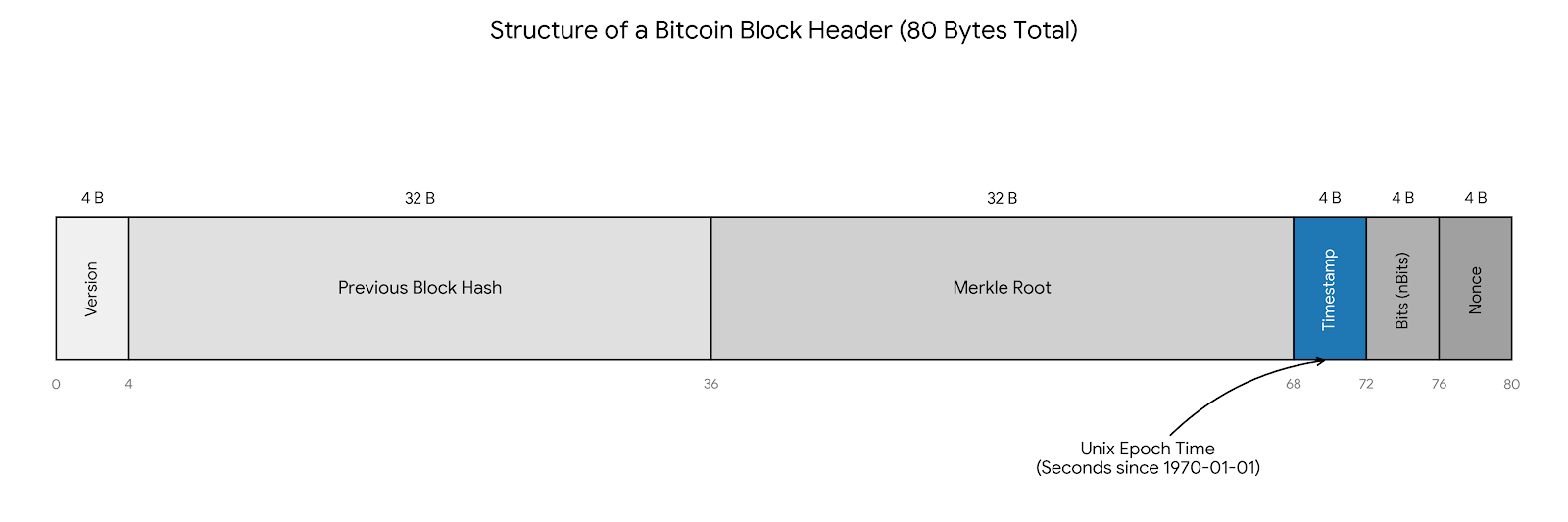
Currently, Bitcoin has two rules for writing timestamps [5]:
1. It cannot be smaller than the median of the previous 11 blocks’ timestamps.2. It cannot be greater than each node’s network-adjusted time + 2 hours.
The attacker, seeking bigger mining returns, can theoretically game this design. The attack relies on the fact that the median calculation ignores timestamp outliers. This allows the attacker to write many “dishonest” timestamps to manipulate the median, followed by one “honest” timestamp that does not impact the median. This example attack is carried out in three phases:
1. The Hold Back: The attacker mines each of the 2,014 blocks of the period, made possible because the attacker is assumed to have 51% control of the hashpower). Let’s say that the last timestamp of the previous period was 1,000,000. The attacker maliciously sets their 2,014 blocks to be only one second apart from each other: 1, 000,001, 1,000,002, ..., 1,002,014. If they were to calculate the median of this period, they would get a value far smaller than reality. Perhaps 2 weeks have passed in the real world, but judging solely from the attacker’s timestamps, the network believes only 2,014 seconds have elapsed.
2. The Jump: The attacker arrives at the 2,015th block, which is the last block of the retargeting period. The attacker does not want the network to suspect they mined these blocks instantly. So, for this single block, the attacker sets the timestamp forward to the maximum allowed by Rule #2. Let’s say this jumps the timestamp to 2,209,600.
3. The Warp: The attacker is now mining the first block of the next period. The median of the last 11 blocks is still calculated based on their ”held back” blocks from Phase 1. Because the median ignores the single outlier from Phase 2, the network allows them to write a timestamp just a few seconds after the 2,014th block. The attacker sets the timestamp to 1,002,015.
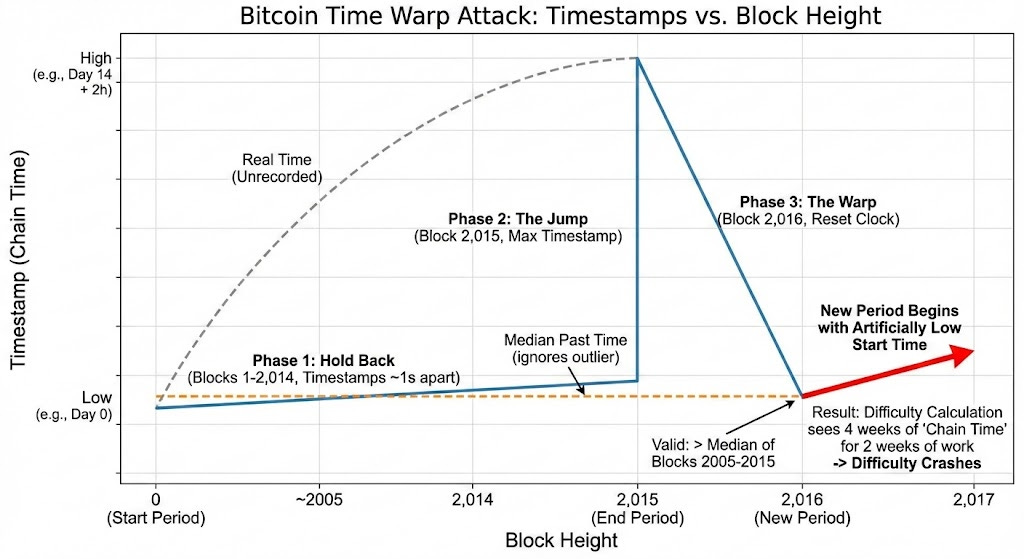
Notably, this timestamp is significantly smaller than its predecessor (recall the 2,015th block was at 2,209,600). The attacker has now effectively erased two weeks of time from the blockchain’s perspective for the start of the new period. At the end of this new period, the difficulty formula will calculate the duration from the attacker’s “warped” start (1,002,015) to the real-time end (3,400,000+). The formula will see that, apparently, an unreasonably long time has passed (roughly 4 weeks of perceived time for 2 weeks of work) and decide that mining is too hard. It will then drastically slash the difficulty, allowing the attacker to mine even faster and more profitably.
Notice that the same median-rule loophole permits a more severe arithmetic anomaly known as the Murch-Zawy vulnerability. By manipulating the first block of a period to have a timestamp far in the future (a valid outlier), an attacker can mine the subsequent blocks fast enough such that the period ends “before” it began (TLast < TFirst). While the Time Warp attack inflates time, it creates a negative duration. Because Bitcoin uses unsigned integers, this negative value “underflows” to a massive number, causing the network to incorrectly perceive a century-long delay and causing a maximally possible downward difficulty adjustment in mining.
In addition to empowering a single 51% attacker, we could imagine a scenario in which it is in the interest of short-sighted miners, and short-sighted users, to collude and exploit this vulnerability.
• Miners: If they manipulate timestamps to achieve an 8-minute block interval compared to the current 10 minutes, they increase revenue by 20%.
• Users: Faster blocks mean more block space per hour, which, all other things being equal, brings transaction fee rates down.
This possible collusion creates a dangerous alignment where profit-seeking participants might prefer a “warped” chain, eroding the assumption that honest players will defend consensus rules.
BIP 54
This “Time Warp” vulnerability is addressed in BIP 54 (aka Consensus Cleanup), authored by Bitcoin contributors Antoine Poinsot and Matt Corallo [2].
Brief Overview of BIPs
BIP stands for “Bitcoin Improvement Proposal.” Analogous to the “Request for Comments” (RFC) documents used to build the internet, BIPs are the primary mechanism in Bitcoin for proposing new features, collecting community input, and documenting the design decisions that go into Bitcoin. Those interested in learning about open source Bitcoin development can start with reading some of the foundational BIPs adopted by the network: BIP 340 (Schnorr); BIP 341 (Taproot); BIP 32 (Hierarchal Deterministic Wallets).
Bitcoin development is the opposite of the common tech trope of “moving fast and breaking things.” Because Bitcoin has no central leader or headquarters, publishing a BIP does not instantly change the code running on the thousands of nodes worldwide. For a BIP to become reality, it must pass through a rigorous process of peer review, debate, and finally, widespread adoption by the node operators and miners who power the network.
Fixing Time Warp
Recall that an attacker could take advantage of the timestamp median rule loophole to manipulate difficulty adjustment. BIP 54 proposes imposing strict sanity checks on timestamps at the boundaries of the difficulty period:
• Anti-Warp Rule: The timestamp of the first block of a new period (TN ) must be greater than or equal to the previous block’s timestamp (TN−1) minus 7,200 seconds.
TN ≥ TN−1 − 7200
• Murch-Zawy Fix: The last block of a period cannot have a timestamp smaller than the first block of the same period (TLast ≥ TFirst), preventing negative duration calculations.
Preventing ”Poison Blocks” (Validation DoS)
Beyond the Time Warp problem, BIP 54 addresses the “Poison Block” vulnerability. Currently, it is possible for an attacker to maliciously craft a “Poison Block” in Bitcoin that is small in data size but computationally expensive to verify via repeated calling of Bitcoin script opcodes. These blocks can take minutes or even hours for low-end nodes to process, effectively constituting a form of censorship against computationally constrained miners.
Consider the following example of an attack script using OP CHECKMULTISIG, a script command that validates multiple signatures against a list of public keys, requiring significantly more computation than a standard signature check. In this attack, each input forces up to 15 signature checks. With hundreds of inputs, a single transaction can force thousands of expensive cryptographic operations even if the block is not large in bytes.
Below is an example of TxPoison:
TxPoision:
vin:
- spends P2SH(15-of-15 multisig)
- spends P2SH(15-of-15 multisig)
- spends P2SH(15-of-15 multisig)
...
An unreasonably complex and useless multisig script like this is done only to maximize the amount of validation computation. This is because if a single key is lost, the funds are burned forever, which defeats the entire purpose of multisig. BIP 54 introduces a “Signature Operation Limit.” It specifies a logic of counting operations: one CHECKSIG is counted as 1; CHECKMULTISIG is counted as 1-16 operations when immediately preceded by OP 1 through OP 16, otherwise it is counted as 20. If the total count exceeds 2,500, the transaction is made invalid. This fix claims to reduce the worst-case block validation time by a factor of 40, ensuring that nodes stay synced without requiring datacenter-grade hardware.
Merkle Tree Ambiguity
BIP-54 also fixes a subtle cryptographic vulnerability that exists in the Bitcoin Merkle tree construction. In a Merkle tree, the inner nodes are created by hashing two 32-byte child hashes together, resulting in a 64-byte string. However, a transaction can also be 64 bytes long. This creates a structural ambiguity where the protocol could misinterpret a transaction as a branch of the tree, allowing attackers to fake inclusion proofs and submit invalid transactions. BIP 54 solves this by simply invalidating any transaction that is exactly 64 bytes in size, thereby removing this vulnerability [4].
Legacy Duplicate Transactions
Finally, BIP 54 cleans up a legacy issue regarding duplicate transaction IDs. While modern blocks (post 2012) require the block height in the coinbase scriptSig to ensure uniqueness, there are ancient coinbase transactions that could theoretically be duplicated in the future (up to around block height 1,983,702). To fix this, BIP 54 utilizes two standard transaction fields:
• nLockTime: A restriction that prevents a transaction from being mined before a specific block height, similar to post-dating a check.
• nSequence: A field which, when set to a “non-final” value (e.g., 0), signals to the network that the nLockTime restriction must be enforced.
BIP 54 mandates that the nLockTime of the coinbase transaction must be set to Block Height - 1, and nSequence must be enabled (i.e., set to 0).
This configuration creates a “forward-compatible only” transaction. For example, a coinbase at height 1,000,000 will carry an nLockTime of 999,999. If the network checked this transaction against any point in the past (e.g., height 500,000), it would be rejected because the locktime has not yet been reached. This guarantees that future coinbase transactions are mathematically distinct from all historical ones, removing the need for expensive duplicate checks.
Conclusion
The vulnerabilities addressed by BIP 54—Time Warp, Poison Blocks, Merkle Tree Ambiguity, and Transaction Duplication—range from theoretical economics to cryptographic edge cases. By bundling these fixes into a single “Consensus Cleanup,” BIP 54 tries to protect the economic invariants of the system through stringent mathematical rules.
There has always existed tension in the ecosystem between “ossification,” the idea that the protocol should stop changing to maximize stability and “cleanup,” the need to fix known tech debts. BIP 54 is a test of the latter. It offers no new features: no smart contracts, no privacy tech, no throughput increases. It is purely preventative, addressing known but potentially dangerous vulnerabilities if left unpatched.
References
1. Strike. “What is Bitcoin’s Difficulty Adjustment?” Strike Learn. Available at: https://strike. me/en/learn/what-is-bitcoin-s-difficulty-adjustment/
2. Poinsot, Antoine, and Matt Corallo. “BIP 0054: Consensus Cleanup.” Bitcoin Improvement Proposals, GitHub. Available at: https://github.com/bitcoin/bips/blob/master/bip-0054. md
3. Bitcoin Optech. “Cleanup soft fork proposal.” Bitcoin Optech Newsletter #36, 5 March 2019. Available at: https://bitcoinops.org/en/newsletters/2019/03/05/#cleanup-soft-fork-proposal
4. Bitcoin Optech. “Mitigating Merkle tree vulnerabilities.” Bitcoin Optech Newsletter #319, 6 September 2024. Available at: https://bitcoinops.org/en/newsletters/2024/09/06/#mitigating-merkle-t
5. Bitcoin Wiki. “Block timestamp.” Available at: https://en.bitcoin.it/wiki/Block_timestamp 5