

Stanford Blockchain Review
Volume 8, Article No. 10
✍🏻 Author: Anya Phan - Stanford Blockchain Club
⭐️ Technical Prerequisite: Beginner
Regulating Crypto Through CLARITY
For over a decade, U.S. crypto markets have operated in a legal gray zone. There currently exists no clean definitions for digital asset categories, making it difficult to separate digital securities from digital commodities. This means that neither the Securities and Exchange Commission (SEC) nor the Commodity Futures Trading Commission (CFTC) can determine where their respective purview ends. Furthermore, because these systems were built to operate without intermediaries, enforcement reaches only parts of the stack: exchanges, custodians, issuers.
Regulators have hardly been idle, with the SEC and CFTC bringing case after case against incorporated entities. This, coupled with the rapid growth of DeFi, has left both agencies messily asserting authority one lawsuit at a time, in place of rules they could not write. Enter the Digital Asset Market Clarity Act, better known as the CLARITY Act, which aims to inject clarity.
Political Context
President Trump has aligned his administration with the crypto sector. Since starting his second term in office, he has signed an executive order promoting U.S. leadership in digital assets,[1] directed the Department of Treasury to establish a Strategic Bitcoin Reserve and U.S. Digital Asset Stockpile,[2] and signed the GENIUS Act for stablecoins into law.[3] Additionally, Secretary of the Treasury Scott Bessent has voiced support for digital assets, stating, “Stablecoins represent a revolution in digital finance. The dollar now has an internet-native payment rail that is fast, frictionless, and free of middlemen.”[4] Yet despite support from the Executive Branch, the specifics of token regulation are still being debated. The absence of clear rules has left many prospective retail and institutional investors in legal uncertainty, keeping many potential participants on the sidelines.
Some crypto market participants argue that government regulation is antithetical to the DeFi ethos; this objection is even echoed by some inside the Securities Exchange Commission (SEC). In 2020 remarks proposing a safe harbor for token networks, SEC Commissioner Hester M. Peirce put the point directly: “A core benefit of a token network is its non-reliance on intermediaries; people transact directly with one another. Having to buy or sell tokens through a registered broker-dealer or on a registered exchange certainly puts a damper on the development of a thriving, decentralized crypto network.”[5] The concern is real but narrower than usually stated. A regulator may not undermine censorship resistance at the protocol level, but it can make that resistance practically irrelevant for users who rely on regulated platforms.
CLARITY Complements GENIUS
The GENIUS Act, signed into law in July 2025, establishes federal regulations on stablecoin issuance. It requires 100% reserve backing with highly liquid assets, such as U.S. dollars or short-term Treasuries, imposes a monthly public disclosure requirement for issuers, and forbids yield payment at the issuer level.[3] Even before GENIUS was signed into law, House Financial Services Committee Chairman French Hill began pushing for market-structure regulation, which resulted in CLARITY. GENIUS set the stablecoin-defining groundwork, while CLARITY seeks to specify the overarching market structure — namely, the distinction between digital securities and commodities and their regulation.
Defining Digital Assets
CLARITY defines the digital commodity category as: “a digital asset that is intrinsically linked to a blockchain system, and the value of which is derived from or is reasonably expected to be derived from the use of the blockchain system.”[6] Digital commodities would fall under the Commodity Futures Trading Commission (CFTC) purview, with the SEC retaining jurisdiction over the investment contracts through which such assets are initially sold. The CFTC would hold exclusive jurisdiction over spot markets in digital commodities, and digital commodity exchanges must register and meet core principles covering listing standards, trade surveillance, conflict management, reporting, and system safeguards. Meanwhile, the SEC would administer issuer disclosure for digital commodities and retain anti-fraud authority over transactions on SEC-registered venues.[6]
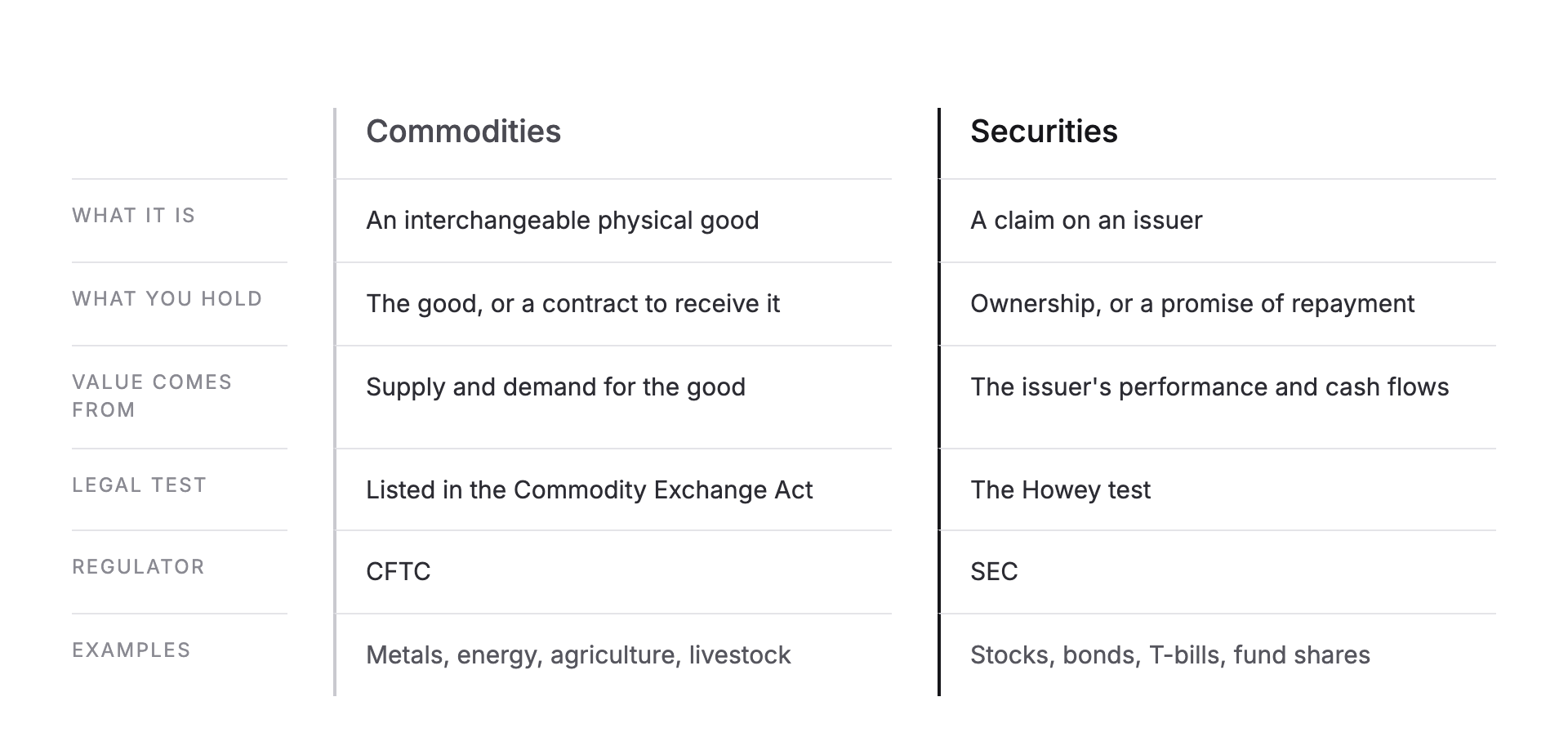
Commodities vs. Securities comparison
Issuers of digital commodities may be exempt from the registration requirement of the Securities Act of 1933 if the underlying blockchain is certified as mature. This requires, among other criteria, that the commodity token’s value is substantially derived from the blockchain’s use and functioning, that no holders are privileged or restricted relative to others, and that holdings by certain classes of holders stay under 20% of outstanding units. An issuer may also rely on the exemption if it intends for the blockchain to reach maturity within four years, though pre-maturity issuers carry additional reporting obligations. Either way, sales are capped at $50 million over any 12-month period, and the issuer must file an offering statement and ongoing disclosures with the SEC in lieu of registration.[6],[7]
Additionally, CLARITY would expand the range of regulated firms able to intermediate crypto trading beyond crypto-native firms like Coinbase and Kraken. National banks aren’t barred today: the Office of the Comptroller of the Currency (OCC) confirmed that custody and related activities are permissible and dropped its prior-approval requirement,[8] later clarifying that banks may buy and sell assets held in custody at the customer’s direction.[9] But spot intermediation is licensed state by state, layered on FinCEN’s Anti-Money Laundering (AML) registration, with no federal market-structure regime above it. CLARITY would create one, registering digital commodity exchanges, brokers, and dealers with the CFTC, and would open those roles to non-bank subsidiaries of holding companies by adding digital commodity activity to the Bank Holding Company Act’s list of activities that are financial in nature.[6] The real gain is durability: an interpretive letter can be withdrawn by the agency that wrote it, while a statute takes an act of Congress, which is far more difficult to be overturned.
Questions Needing CLARITY
Many in Congress endorse the bill’s purpose and overall intent but are unwilling to support the legislation in its current form. Some are concerned with the restriction on stablecoin rewards, in this case payments funded by the yield issuers earn on reserves and passed to users by third-party exchanges (e.g., Coinbase, Robinhood). While GENIUS explicitly prohibits issuers from directly paying yield to holders, the act does not expressly prohibit affiliate rewards, in which affiliated or third-party platforms provide holders with interest-like returns through payouts. A January 2026 Senate Banking draft moved to close this gap, extending the prohibition on yield paid solely for holding a stablecoin beyond issuers to digital asset service providers, though with a broad carve-out for activity-based rewards.[10] The banking lobbyists argues these restrictions are necessary to prevent large-scale deposit flight, which they assert would reduce the supply of credit. [11],[12] The Crypto Industry countered that a ban would relocate the activity offshore rather than end it, and could sweep in unrelated lending yield. The resulting compromise permits activity-based rewards (things like transacting or referring other users to the platform) while restricting those that function like deposit interest.[13],[14] The OCC has separately proposed a rule presuming affiliate-linked yield violates GENIUS, which would reach a narrower version of the same result without Congress, for the issuers it supervises.[15]
Passage and Voting
CLARITY was introduced in the House of Representatives on May 29, 2025 by House Financial Services Committee Chair French Hill. The bill passed in the House on July 17, 2025 and was sent to the Senate.[16] The Senate Agriculture Committee independently advanced the Digital Commodity Intermediaries Act on a 12–11 party-line vote in January,[17] and the Senate Banking Committee advanced its own substitute text for H.R. 3633 on May 14, 2026 by a 15–9 vote.[18] Committee process is no longer the binding constraint: the bill has sat on the Senate Legislative Calendar since the committee formally reported it on June 1, eligible for floor consideration.[16] The constraint is arithmetic. Clearing cloture requires at least seven Democratic votes, and more for every Republican defection. [19] Absent a deal on that language, the framework governing U.S. digital asset markets remains agency guidance and rulemaking, which is to say clarity that a future administration can withdraw.
This discourse came to a head on September 15, 2026, when the Senate voted 49–50 against advancing CLARITY, eleven votes short of the 60 required.[20] The failed vote stalled the legislation ahead of the midterm elections, leaving the SEC and CFTC to continue carrying much of the regulatory burden through agency action rather than the durable statutory framework CLARITY sought to create. A motion to reconsider keeps CLARITY procedurally alive, but a renewed attempt is unlikely before the post-election lame-duck session. If the bill is not enacted before the current Congress ends on January 3, 2027, it will have to be reintroduced.[20]
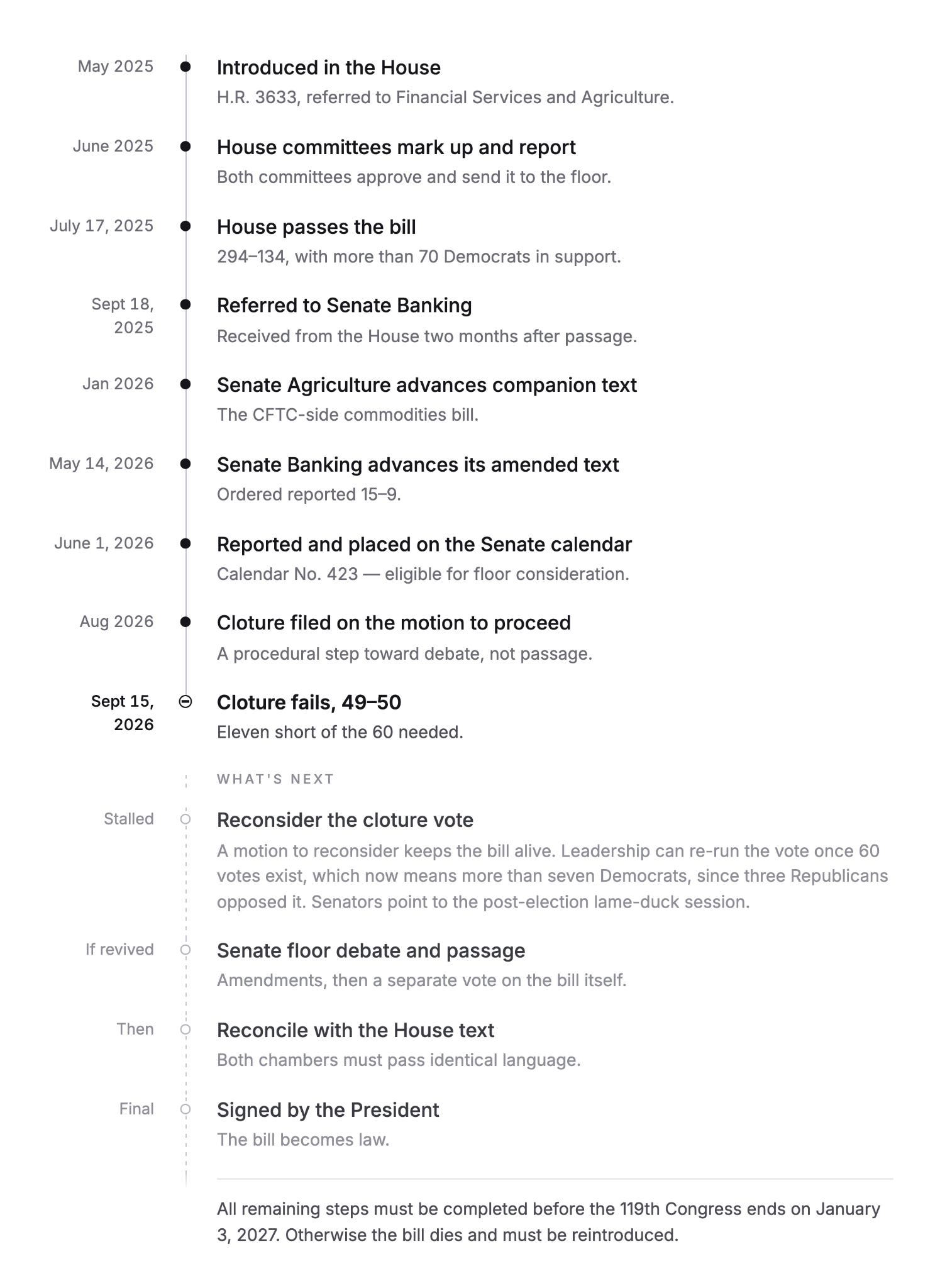
CLARITY legislation process
Committee Republicans have argued that the bill contains the strongest illicit finance framework Congress has considered for digital assets, citing anti-money-laundering obligations on key intermediaries, tightened sanctions compliance, and new Treasury authority over high-risk foreign activity.[21] That characterization is disputed from more than one direction. Banking trade associations have argued the opposite, that existing law already reaches crypto AML and that the bill would open new gaps, while committee Democrats unanimously backed an amendment extending Treasury’s sanctions authority to DeFi services that Republicans rejected on a party-line vote.[22]
Closing
The CLARITY Act seeks to increase regulatory certainty for digital asset trading by defining a category of digital commodities distinct from digital securities, and by creating a path for a token first sold under an investment contract to be reclassified as a commodity once its underlying blockchain is certified mature. Debate over the text has shifted from stablecoin rewards, largely settled by the May compromise, to ethics provisions covering senior government officials, the issue on which the September cloture vote failed.[19],[20]
References
[1] Exec. Order No. 14178, Strengthening American Leadership in Digital Financial Technology, 90 Fed. Reg. 8647 (Jan. 31, 2025) (signed Jan. 23, 2025), https://www.federalregister.gov/documents/2025/01/31/2025-02123/strengthening-american-leadership-in-digital-financial-technology.
[2] Exec. Order No. 14233, Establishment of the Strategic Bitcoin Reserve and United States Digital Asset Stockpile, 90 Fed. Reg. 11789 (Mar. 11, 2025) (signed Mar. 6, 2025), https://www.federalregister.gov/documents/2025/03/11/2025-03992/establishment-of-the-strategic-bitcoin-reserve-and-united-states-digital-asset-stockpile.
[3] Guiding and Establishing National Innovation for U.S. Stablecoins Act, Pub. L. No. 119-27, 139 Stat. 419 (2025), https://www.congress.gov/bill/119th-congress/senate-bill/1582/text.
[4] Press Release, U.S. Dep’t of the Treasury, Statement from U.S. Secretary of the Treasury Scott Bessent on Enactment of the GENIUS Act (July 18, 2025), https://home.treasury.gov/news/press-releases/sb0197.
[5] Hester M. Peirce, Comm’r, U.S. Sec. & Exch. Comm’n, Running on Empty: A Proposal to Fill the Gap Between Regulation and Decentralization (Feb. 6, 2020), https://www.sec.gov/newsroom/speeches-statements/peirce-remarks-blockress-2020-02-06.
[6] Digital Asset Market Clarity Act of 2025, H.R. 3633, 119th Cong. (as passed by House, July 17, 2025), https://www.congress.gov/bill/119th-congress/house-bill/3633/text/eh.
[7] Cong. Rsch. Serv., Crypto Legislation: An Overview of H.R. 3633, the CLARITY Act (updated Sept. 30, 2025), https://www.congress.gov/crs-product/IN12583.
[8] OCC Interpretive Letter No. 1183 (Mar. 7, 2025), https://www.occ.gov/topics/charters-and-licensing/interpretations-and-decisions/2025/int1183.pdf.
[9] OCC Interpretive Letter No. 1184 (May 7, 2025), https://www.occ.gov/topics/charters-and-licensing/interpretations-and-decisions/2025/int1184.pdf.
[10] Latham & Watkins, US Crypto Policy Tracker: Legislative Developments (last visited Sept. 18, 2026), https://www.lw.com/en/us-crypto-policy-tracker/legislative-developments.
[11] Bank Policy Inst., Closing the Payment of Interest Loophole for Stablecoins (Aug. 12, 2025), https://bpi.com/closing-the-payment-of-interest-loophole-for-stablecoins/.
[12] Banks, Crypto Clash over Stablecoin Rewards in Key Senate Bill, The Hill (Jan. 15, 2026), https://thehill.com/policy/technology/5689481-crypto-banking-lobbying-fight/.
[13] Clarity Act Text Lets Crypto Firms Offer Stablecoin Rewards While Shielding Bank Yield, CoinDesk (May 1, 2026), https://www.coindesk.com/policy/2026/05/01/clarity-act-text-lets-crypto-firms-offer-stablecoin-rewards-while-shielding-bank-yield.
[14] Senate Banking Committee Advances CLARITY Act in Bipartisan Vote, Troutman Pepper Locke Fin. Servs. Blog (May 15, 2026), https://www.troutmanfinancialservices.com/2026/05/senate-banking-committee-advances-clarity-act-in-bipartisan-vote/.
[15] Sullivan & Cromwell LLP, GENIUS Act Implementation: OCC Issues Proposed Rules (Mar. 11, 2026), https://www.sullcrom.com/insights/memo/2026/March/OCC-Proposes-Regulations-Implement-GENIUS-Act.
[16] Actions — H.R. 3633 — 119th Congress (2025–2026): Digital Asset Market Clarity Act of 2025, Congress.gov, https://www.congress.gov/bill/119th-congress/house-bill/3633/all-actions.
[17] Senate Ag Committee Advances Digital Commodity Bill, ABA Banking J. (Jan. 29, 2026), https://bankingjournal.aba.com/2026/01/senate-ag-committee-advances-digital-commodity-bill/.
[18] Press Release, S. Comm. on Banking, Hous., & Urban Affairs, Chairman Scott Leads Historic Markup of Digital Asset Market Structure Legislation (May 14, 2026), https://www.banking.senate.gov/newsroom/majority/chairman-scott-leads-historic-markup-of-digital-asset-market-structure-legislation.
[19] White House Pushes Back as Key Democrats Reject CLARITY Act’s Crypto Ethics, CryptoSlate (July 23, 2026), https://cryptoslate.com/white-house-pushes-back-as-key-democrats-rejects-clarity-acts-crypto-ethics/.
[20] US Senate Fails to Advance Sweeping Cryptocurrency Bill in Blow for Industry, Reuters (Sept. 15, 2026), https://www.reuters.com/legal/government/us-senate-vote-advancing-landmark-crypto-bill-2026-09-15/.
[21] S. Comm. on Banking, Hous., & Urban Affairs, Myth vs. Fact: The CLARITY Act, https://www.banking.senate.gov/newsroom/majority/myth-vs-fact-the-clarity-act.
[22] Crypto Regulatory Affairs: CLARITY Act Advances from Senate Banking Committee, Elliptic (May 2026), https://www.elliptic.co/insights/crypto-regulatory-affairs-clarity-act-passes-senate-banking-committee/.